


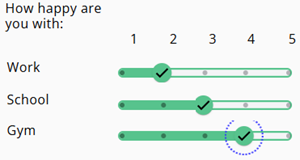
A range slider grid allows respondents to provide scores for multiple related questions using sliders instead of fixed answer options.
Similar to a single-select grid, it is suitable for questions such as: “How happy are you with…”, followed by topics like work, school, or gym.
In this layout, the questions are listed vertically, while each row contains a slider with a defined minimum and maximum value (for example, 1 to 10). Respondents can select any value within this range by moving the slider. This format offers greater flexibility and a more interactive way to capture responses.
The construction of a min/max slider grid involves a few steps, which are described below.
A Range node is automatically created when the type of grid is selected. If the setup is canceled, the node can be removed by pressing Cancel and Remove.
Step 1: The columns

The columns in the grid represent the possible answers to each question, such as a score from 1 to 10. Answers can be entered manually or quickly added using the copy-paste option.
Step 2: The rows
The rows in the grid are the different questions, each row corresponds to a question text. And the different questions can be entered manually or copy pasted.
Step 3: Basename
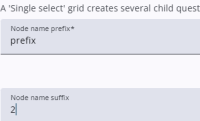
A min/max slider grid automatically creates the child nodes, and their naming can be configured here. The prefix defines the base of each child node, while the suffix determines the final part of the name. In this example, the first child would be named prefix2 and the second prefix3.
It is also possible to use letters instead of numbers for sequencing, such as a, b, and c.
The result
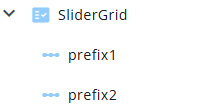
The result is a Range node with MinMax nodes as its children. The categories for these lists are managed at the first child level, ensuring that all child nodes share the same set of response options for consistency.